Hear from founding Executive Producer of Independent Lens at ITVS, Lois Vossen, about the state of the documentary filmmaking landscape
Photo by Pamela Gentile
A dynamic hub for influential conversations about non-fiction funding and the state of the industry, Doc Congress is an annual gathering that takes place during SFFILM’s Doc Stories. By bringing together documentary funders, filmmakers, and distributors to discuss the most prevailing topics of the non-fiction funding landscape, Doc Congress is one of the documentary showcase’s most vital events.
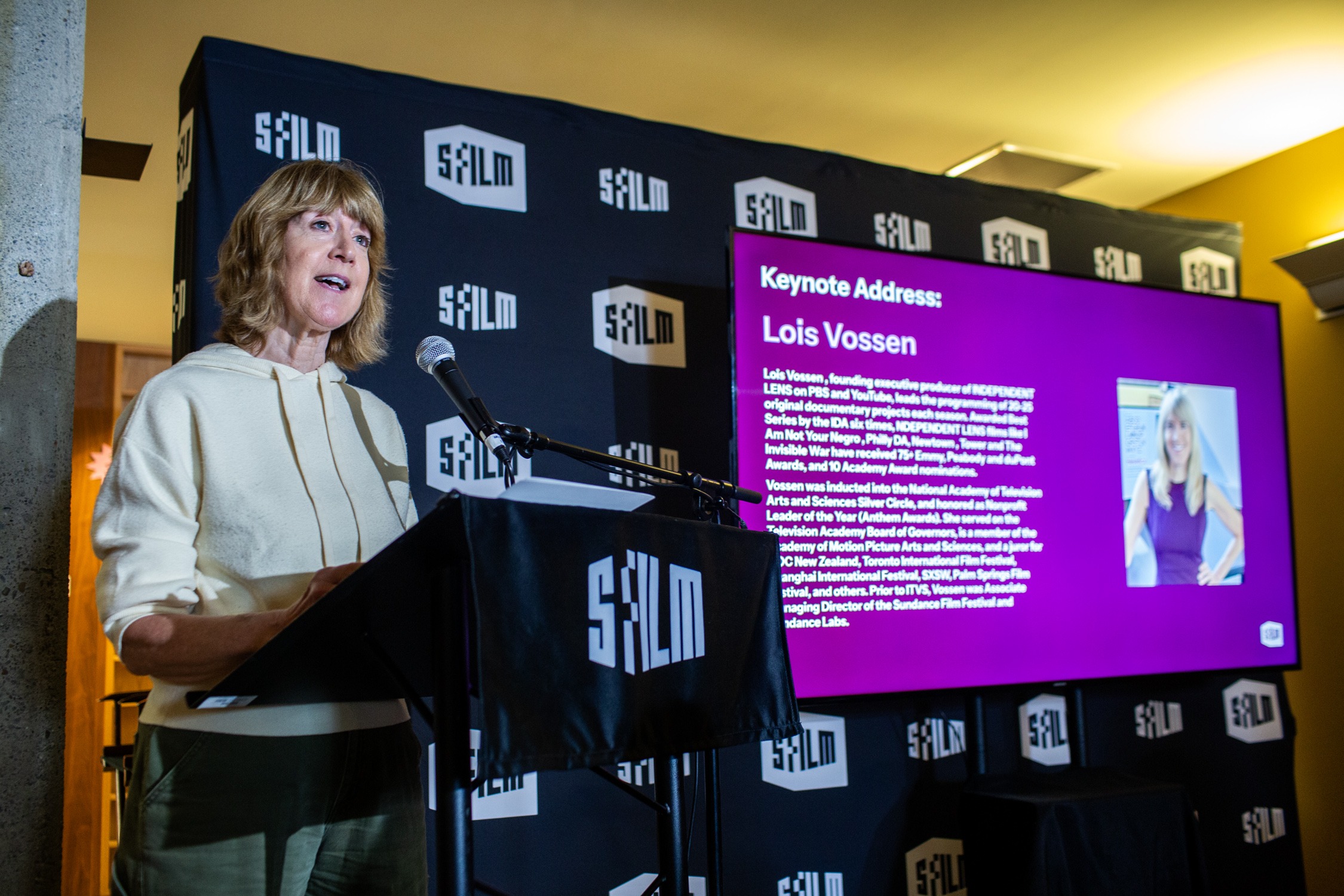
At the the 2025 Doc Stories festival, Lois Vossen, founding Executive Producer of Independent Lens at ITVS, served as Doc Congress’ keynote speaker. Revisit Vossen’s compelling address here.
2025 Doc Stories Doc Congress Keynote Speech
I want to acknowledge Carrie Lozano, our president at ITVS and other colleagues who are here. I’m grateful to be part of such an incredible team.
This year I’ve found myself repeating something to filmmakers, potential ITVS funders, members of our Board, my co-workers, and documentary investors. If the women and men who organized and fought for almost a decade to create ITVS in the 1980s were undertaking that almost unfathomable task today I’m pretty sure their strategy and goal would not be to secure federal funding to make only 90-minute documentaries for broadcast television.
To secure public money, they would look at the current landscape—how media is being made, how stories are being told, how information and misinformation reach audiences, what stories audiences are getting and especially what stories they’re not getting. That is the job of non-profits like ITVS: to look for the gaps in the commercial marketplace and try to fill them.
They would still see a critical need for stories intentionally made to inform, educate and inspire (as opposed to being made to feed a bottom line, or just to win awards, or just to make money). Not that those are bad things; they’re not our Congressional Mandate.
The founders would see an opportunity even bigger than (and we think as exciting as) the circumstances that led to ITVS’s original creation.
Photo by Pamela Gentile
Back in 1988 when the ITVS legislation was signed there were four television networks and only one of those, PBS, was designated to serve the public. So to get federal funding today, I think the case would need to be made as to why and how we should harness the power of independent storytellers to serve audiences where they are now—on a variety of platforms and feeds.
Not where they used to be. Or where we wish they were.
As political lines harden and create deeper communication divides, we risk talking in echo chambers, our stories just going to people who already agree with us or think the way we think unless we find a way to get authentic, honest information (aka our stories) on platforms and feeds where new generations are getting their news. Unless we truly reach beyond our choir.
The need for independently produced, nonfiction programming made in the public interest is as profound as ever but to reach tens, actually hundreds of millions of Americans we need to expand how we think about audiences, how we talk with audiences and where stories reach audiences.
That’s the first step to build a broader ecosystem that uses readily available technology, improves access, and takes advantage of new devices and platforms so our stories land where the audience is most likely to find and consume them.
It’s a way to elevate Creatives, mobilize philanthropy, and ensure that a diversity of voices remains central in this work. It’s how we help shape the next generation of media that serves the public interest.
This will require some of us to step out of our comfort zone. But the upside is that we get to create different visual languages. We get to conceive, make, fund, and present multiple ways to tell stories that work on the specific platform they are created for.
Photo by Pamela Gentile
I want to take a moment and assure you that I’m not suggesting we stop making feature films. I love them. You love them. Audiences love them. Our documentary The Librarians, for example, is selling out nearly all of their theatrical screenings. And I’m not just talking about being held for a 4th week at Film Forum in New York City. It’s selling out in Iowa and Dallas, in Salt Lake City and Modesto, and Shreveport, Louisiana.
Long form documentaries can uniquely contextualize issues and serve as a timeless history. They still connect with audiences in theaters, in classrooms, and online.
But there’s room and a need for other forms of nonfiction storytelling. And that’s also part of our job at ITVS and INDEPENDENT LENS. To find new ways to support creators who want to make smart, authentic, relevant, surprising programs specifically for the audiences already waiting on YouTube and Instagram and other sites. Creators who know how to effectively use these feeds and platforms to unpack and influence culture. Often in real time.
We stand at a generational watershed moment. In many ways, ITVS was built for this moment. We have 34 years of experience identifying and incubating talent, co-funding and co-producing, and very important at this time, we lead community engagement and provide national distribution in purple, red, blue—all of the still United States!
ITVS is Congressionally mandated to serve the American public so in times of change we look for the opportunities. A big one is that we have permission—especially since innovation is written into our mandate—to try new things. And to stop doing things that are no longer effective.
We’re rebuilding after losing the majority of our funding when the Corporation for Public Broadcasting was defunded and we’re also launching new initiatives that put Audiences at the center of our work. Additional programs will be announced in the coming weeks. Today I’m pleased to share information about one: the INDEPENDENT LENS Creator Lab.
Photo by Pamela Gentile
We want to help creators make programming specifically for YouTube, the second most visited website in the world. By partnering with digitally native creators we know we can bring empathy, humor, and hope into feeds and comment sections. We’ll help creators form maker-artist communities who believe in working in the public interest—something our industry has gotten right for decades. And we’ll provide these creators with the production support, editorial scrutiny, and mentorship that is synonymous with ITVS funding.
We’re intentionally calling it the INDEPENDENT LENS Creator Lab to light a path forward for public media.
The call opens November 12, so look for more details next week.
The current paradigm shift allows the creative community opportunities to talk more directly with audiences in ways the ITVS founders couldn’t have imagined when they created this public policy miracle. Now, when media made in the public’s interest is so necessary, we cannot afford to leave millions of audience members behind just because they don’t watch feature documentaries.
We know we can work with storytellers to produce exceptional content that cuts through our differences with the trust and integrity that ITVS has always offered. We’re excited to shape the ITVS that’s most needed today.
Stay In Touch With SFFILM
SFFILM is a nonprofit organization whose mission ensures independent voices in film are welcomed, heard, and given the resources to thrive. SFFILM brings the most exciting films and filmmakers to Bay Area movie lovers all year long. To be the first to know what’s coming, sign up for our email alerts and watch your inbox.